

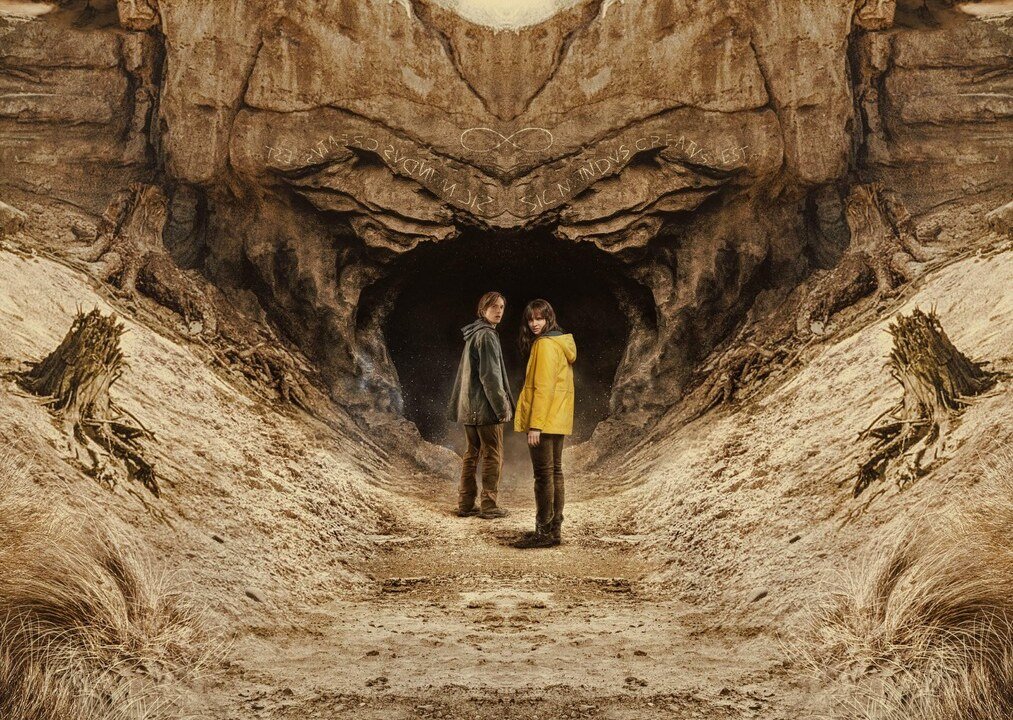
Spoiler warning: This explainer covers the series finale of Dark.
The origin world
Dark’s last hour turns its tangled family tree into a question about causality. Claudia tells Adam that Jonas and Martha’s worlds are not the first reality. In the origin world, H.G. Tannhaus builds a time machine after the deaths of his son’s family. The experiment splits his reality into two, whose tangled generations feed the knot. Netflix’s official summary describes the final season’s loop as bending time and space, but the resolution turns that puzzle into a personal loss.
How the knot breaks
Claudia tells Adam the two worlds are aberrations, products of Tannhaus’s experiment; Adam sends Jonas to Martha, and together they reach the origin world. They intercept Marek, Tannhaus’s son, and Sonja before the car crash; the family turns back and returns to Tannhaus.
Without their deaths, Tannhaus does not make his machine. The two knot-worlds disappear, along with most of their inhabitants, whose existence depends on the interlocking family lines. Regina survives—the outcome Claudia had been trying to secure. The plot mechanics are clear; whether this is a happy sacrifice is a matter of emphasis. Insider’s finale breakdown traces the chain of events.
Does Hannah’s Jonas mean the knot is back?
At the final dinner, Regina, Peter, Hannah, Katharina, Torben and Benni inhabit the origin world. When the lights flicker, Hannah mentions a dream of darkness and déjà vu; she is pregnant and says Jonas would be a beautiful name. The echo is intentional, but it leaves open whether the knot is starting again. The finale shows no new machine or time passage, and never says the child will become the Jonas we knew. The name supports a haunting parallel, not a confirmed resurrection or reboot.
Co-creator Jantje Friese called it both hopeful and ominous in The Hollywood Reporter’s interview. Lisa Vicari similarly says the final dinner can read as a loop or a new beginning without confirming either in a cast interview. Both responses support uncertainty, not a canon answer.
The short answer
The origin world is the causal source; Jonas and Martha break the knot by preventing the deaths that prompted Tannhaus’s experiment. Hannah’s choice keeps the ending emotionally circular, but it does not confirm that the cycle restarts. For more stories like this, browse TV Endings.
0 comments