

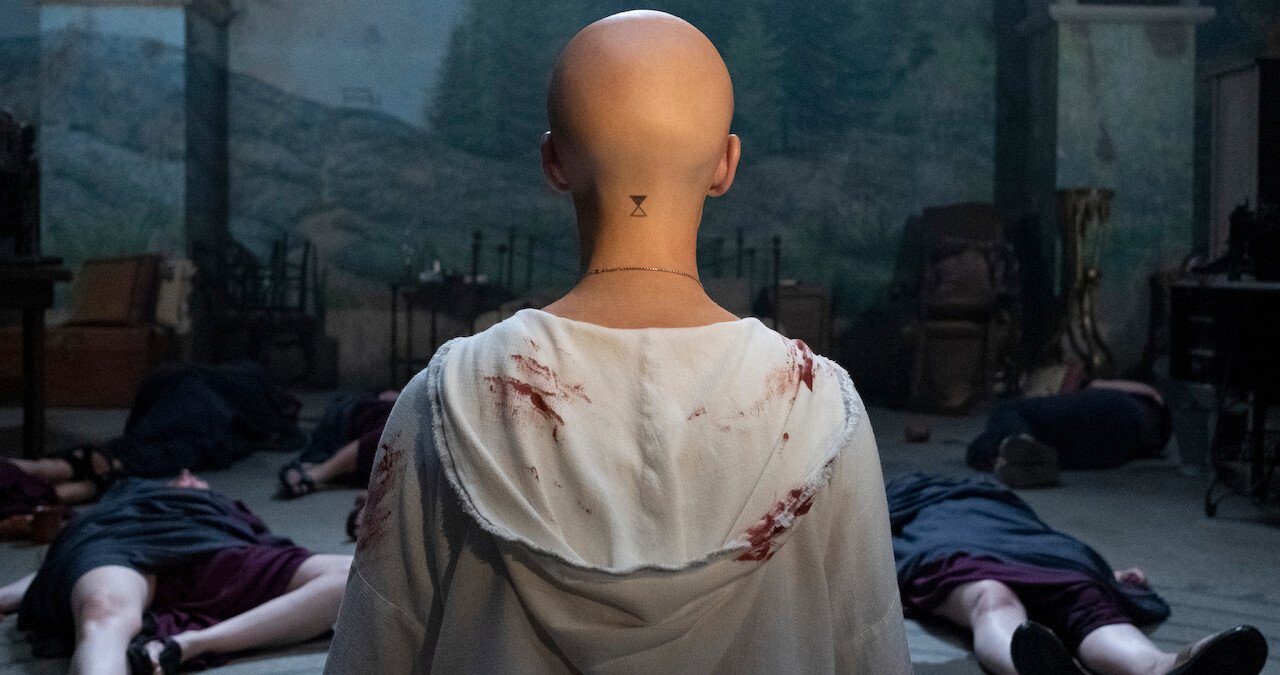
Spoiler warning: Spoilers for Anya’s story and related events in The Midnight Club Season 1. This is not an account of an unproduced continuation.
Anya’s apparent recovery is an imagined future, not evidence that the group’s ritual has cured her. The Midnight Club briefly presents the life she might have lived, then reveals how deeply that vision is assembled from the stories she and her friends have shared.
Why does the episode seem to jump forward?
The ritual is followed by a view of Anya apparently living years later. She works at a supermarket and has survived the illness that killed her friends. At first, the change invites the explanation Ilonka most wants to believe: that the ritual worked.
Details from the club’s stories gradually appear inside that future. Their return identifies it as a construction of Anya’s imagination rather than an ordinary continuation of the outside world.
The device gives the wish real weight before taking away its certainty. Surviving is imaginable, but imagining it cannot make the medical outcome change.
What do the other stories add to her vision?
They supply images and experiences through which Anya can understand what is happening. These are not random references placed beside her final moments; they show how the group’s shared inventions have become part of her private world.
The series’ cast introduction establishes the club as people living with terminal illness who meet to tell stories. That activity gives them something they can choose and shape even when much of their lives is governed by treatment and prognosis.
Anya’s imagined future continues that work. She is not simply waiting silently for an ending someone else describes on her behalf.
Does the repaired ballerina prove she sends a message?
After Anya dies, Ilonka discovers that the damaged ballet figure has been repaired. The object allows a possible supernatural interpretation, but it does not retroactively establish that Anya survived.
The ending keeps the physical death separate from the question of what a sign might mean to the people grieving. A repaired object is observable; a complete explanation of how it happened is not supplied with the same certainty.
Anya’s story therefore offers neither a proven cure nor a simple dismissal of the friends’ connection. The stories mattered because she carried them with her. For Ilonka, the figure becomes something she can hold while deciding how much meaning to give an event she cannot fully explain.
Sources: official ending breakdown; official interview or additional context.